


Beirut – February 4, 2026
The Second Regional Forum on Advancing the Women, Peace, and Security Agenda concluded today in the Lebanese capital, Beirut. The forum was held over two days, from February 3–4, and was jointly organized by the Lebanese National Commission for Lebanese Women and the Euro-Mediterranean Feminist Initiative.
The forum was convened as part of the regional project “Strengthening Feminist Civil Society Organizations to Implement the Women, Peace, and Security Agenda in Iraq, Lebanon, Jordan, and Palestine,” funded by the Support Fund for Feminist Organizations of the French Development Agency (AFD) and the French Ministry for Europe and Foreign Affairs.
Broad Participation and Cross-Border Issues
The forum brought together approximately 160 participants from Lebanon, Iraq, Jordan, Palestine, Syria, Algeria, and Tunisia, in addition to representatives of government institutions, international organizations, donor agencies, and the media.
The sessions addressed cross-sectoral priorities, most notably gender-based violence (including technology-facilitated violence), climate justice, and women’s economic security, with a particular emphasis on the inclusion of women with disabilities, refugees, and internally displaced women.
Ms. Rawan Abu Ghazza, Advocacy Officer at the Psycho-Social Counseling Center for Women, participated in the forum, where she emphasized in her interventions the critical importance of cooperation and coordinated efforts with the Palestinian government, represented by the Ministry of Women’s Affairs, which announced the “Third Generation” National Action Plan related to UN Security Council Resolution 1325.
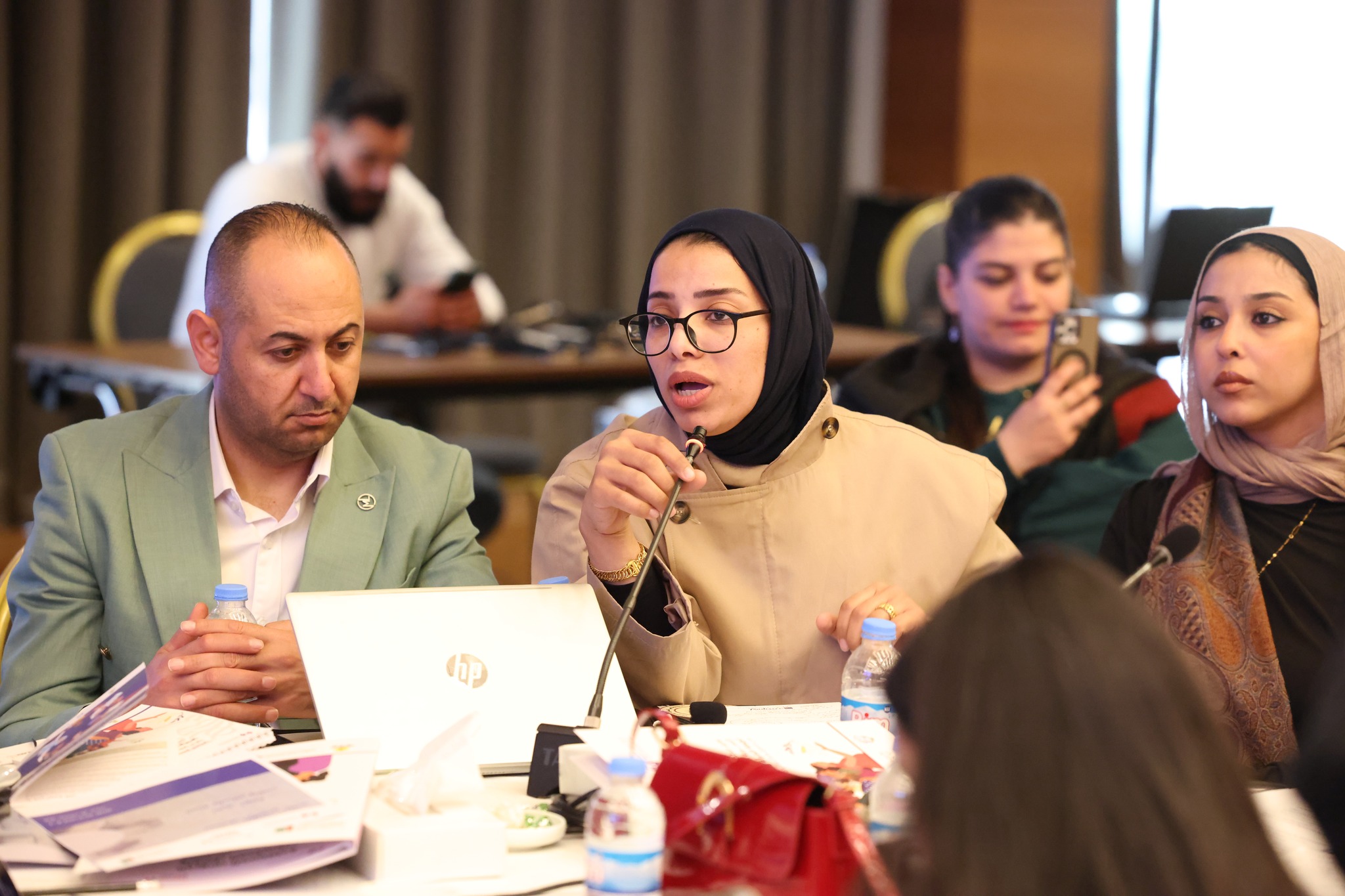
In her remarks, she underscored the need to direct support toward the most vulnerable groups, in particular:
- Women forcibly displaced in displacement camps;
- Women in the Gaza Strip, especially those who are missing or who have lost their children;
- Women affected by settler violence;
- Women human rights defenders.
During the second day’s workshop on transitional processes, which focused on applying transitional justice mechanisms through a Women, Peace, and Security lens, the following recommendations were highlighted:
- Expanding Investigations: Ensuring that fact-finding commissions go beyond cases of rape to include sexual slavery, forced pregnancy, and forced sterilization as war crimes.
- Institutional Reform: Vetting and purging security and judicial institutions of individuals implicated in violations, and aligning national legislation with the Rome Statute of the International Criminal Court.
- Reparations: Providing transformative reparations that guarantee independent housing, education, and healthcare for survivors.
- Political Representation: Ensuring women’s participation in decision-making positions to achieve comprehensive justice, particularly within reconstruction and reconciliation committees.
The forum concluded with an agreement to document its outcomes and recommendations and to disseminate them widely among relevant stakeholders, with the aim of strengthening the implementation of the Women, Peace, and Security agenda in line with emerging developments in the region.


 بيت لحم :
شارع القدس الخليل بجانب شركة الحلا
بيت لحم :
شارع القدس الخليل بجانب شركة الحلا

